


Hearing that dental implants aren’t an option can feel like a door closing permanently. You leave the appointment with a referral that goes nowhere, an X-ray that shows too little bone, and the impression that the anatomy simply won’t cooperate. Most patients stop asking questions at that point, trusting that the person reviewing the scan had the full picture.
At Seattle Smiles Company, we regularly evaluate patients who were told by other providers that implants would never work for them. That conversation doesn’t have to be the final word. Our full arch replacement program begins with a complimentary 3D CT evaluation rather than a flat, planar X-ray, because what’s actually available in a patient’s bone structure can only be understood through imaging that accurately captures depth and density.
What Does “Implants Aren’t an Option” Actually Mean?
When a dentist rules out implants, the most common reason is bone volume. Conventional dental implants anchor into the jawbone and require a minimum density and width to integrate reliably. When that bone has been lost from years without teeth, progressive gum disease, or prolonged denture wear, the available ridge may not support standard placement. This is a genuine clinical limitation, but for many patients it’s a starting point for planning rather than a final answer.
Bone Grafting Can Rebuild What Was Lost
The bone barrier behind an implant refusal is often treatable. Our team performs bone grafting using materials that signal the body to lay down new tissue, gradually widening and deepening a ridge that had shrunk below the threshold for standard placement. The timeline extends, but the outcome shifts from “not possible” to “possible after preparation.” Patients who came in expecting another refusal have moved forward with full arch treatment after this step.
Specialized Implant Designs Work Where Standard Ones Cannot
For patients for whom grafting isn’t the right path, reduced-diameter implant designs are available specifically for compromised anatomy. According to a review on the National Institutes of Health’s biomedical platform, mini dental implants are specifically indicated for patients who cannot receive conventional implants due to limited bone volume, with documented high survival rates and measurable improvements in quality of life across multiple studies. These smaller anchors integrate into areas where ridge width rules out standard placement, and they support implant-retained full-arch prosthetics that provide the kind of stability a loose denture cannot.
Understanding Your Full Arch Replacement Options
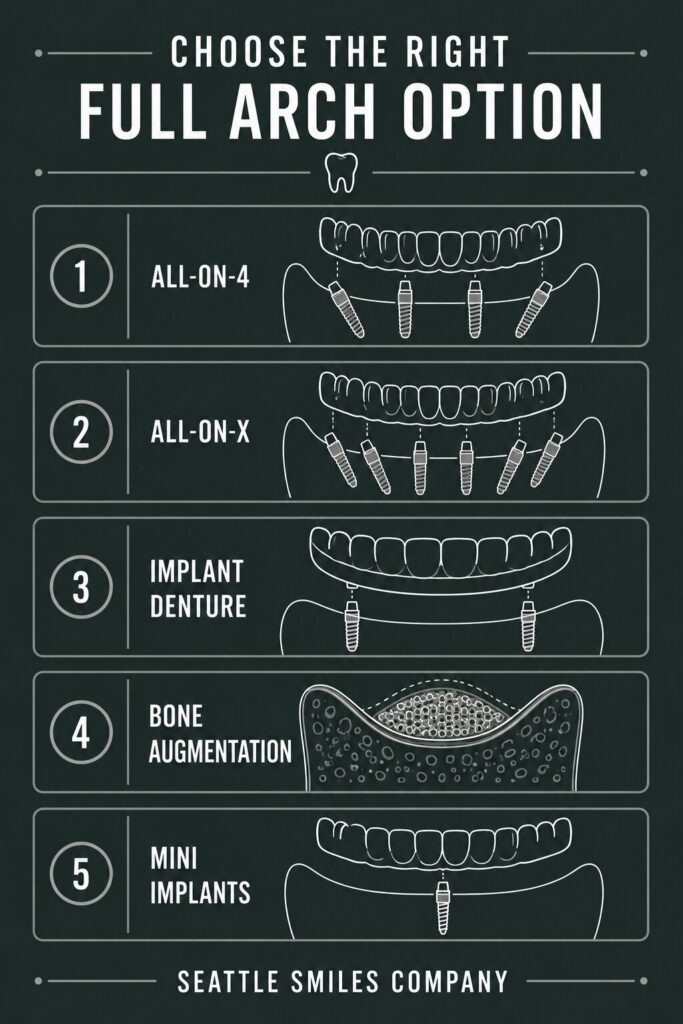
Full arch replacement covers the permanent restoration of an entire row of teeth, upper arch, lower arch, or both. The options available in any given case depend entirely on what the 3D scan reveals about available bone and anatomy. Several paths may be appropriate depending on individual circumstances, including:
- All-on-4 implants, which use four angled placements to work around areas of bone loss
- All-on-X systems, which vary in implant count based on what the individual scan shows
- Implant-retained dentures, which provide implant-anchored stability without a full fixed bridge
- Bone grafting prior to placement, which opens the door for patients with marginal ridge volume
- Mini implants for cases where ridge width rules out standard-diameter placement
The goal in every case is a fixed or anchored result that functions reliably, not a return to removable dentures with no implant support.
Sedation Dentistry Makes Complex Treatment Accessible
For patients who have avoided dental care for years, or who carry real anxiety about surgical procedures, sedation dentistry is a core part of how complex full arch treatment becomes possible at all. Seattle Smiles Company has access to an experienced anesthesia team that includes CRNAs, and our office provides general anesthesia in-house, the same protocol used in hospital surgical settings. Cases requiring multiple stages can be scheduled and completed with the patient sedated throughout, reducing the number of separate visits and easing the process for patients who have already delayed care far too long.
Financing Options That Remove the Cost Barrier
Full-arch replacement is a significant investment, and the cost depends on your situation and the requirements of your treatment plan. We accept some PPO insurance plans and offer multiple financing options through Sunbit, Alphaeon Credit, Proceed Finance, Scratch Pay, and CareCredit. Our membership plan and in-house monthly payment program were built specifically so patients can access complex treatment without the barrier of a high upfront cost.
Schedule a Free Consultation at Seattle Smiles Company
Seattle Smiles Company works with patients who were told implants weren’t possible and who come to us seeking a thorough evaluation rather than a quick dismissal. Our fellowship-trained implant team, including a Fellow of the International Congress of Oral Implantologists and one of the few Fellows of the American College of Dentists in the country, brings the clinical depth to evaluate cases that other offices may not pursue. Our advanced training background at the University of Rochester Eastman Institute for Oral Health informs our approach to complex anatomy, and our in-house CRNA anesthesia team means we can handle cases requiring sedation without referring out. We accept some PPO insurance plans and offer flexible financing options built to make complex treatment accessible through manageable monthly payments.
If you’ve been told full-arch replacement isn’t possible for you, a free consultation and a complimentary 3D CT evaluation may tell a different story. Reach out through our contact form, and let’s take a look at what’s actually available.